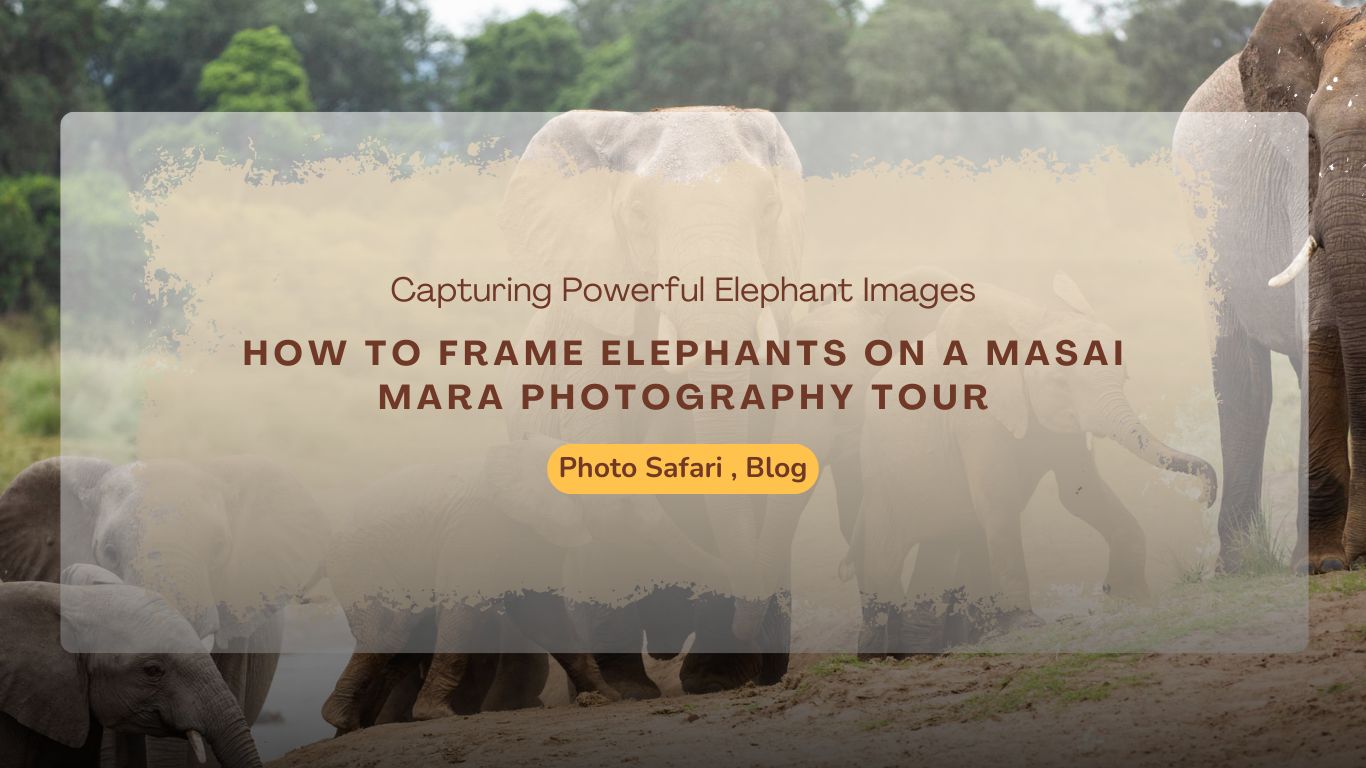
Frame Elephants on a Masai Mara Photography Tour
Elephants are the most visually commanding animals in the Masai Mara. They are also the most misunderstood photographic subject. Most photographers arrive expecting the elephant frame to be straightforward — the animal is large, it moves slowly, it does not hide. What they discover within the first morning is that size is not an advantage when you are behind a lens. It is a challenge.
Framing an elephant well requires a completely different set of decisions from framing a cheetah or a leopard. This guide walks you through every one of those decisions — behaviour, scale, light, position, and gear — so you arrive at your masai mara photography tour prepared to shoot elephants the way they deserve to be shot.
Table of Contents
- Why Elephants Are the Most Challenging Subject in the Mara
- Understanding Elephant Behaviour Before You Raise Your Camera
- The Scale Problem — and How to Solve It in the Frame
- Vehicle Positioning and Distance — Where You Sit Changes Everything
- Gear and Settings for Your Masai Mara Photography Tour
- How Mara Siligi Camp Gets You Closer to the Right Elephant Moment
Why Elephants Are the Most Challenging Subject in the Mara
Ask any wildlife photographer which animal gave them the most technically satisfying image from their trip and the answer is rarely the lion or the cheetah. It is almost always the elephant. Not because elephants are the most dramatic subject in the conventional sense — but because getting an elephant frame right requires every photographic skill you have working simultaneously.
The challenges are specific and consistent across photographers at every level:
- Scale without context collapses — a single elephant against open savannah reads as flat without a reference point. You need the landscape, the herd, or a tree line in frame to give the animal its true scale
- Movement is deceptive — elephants appear slow but cover ground faster than you expect. The ear flap, the trunk curl, the head turn all happen in fractions of a second. Blink and the decisive moment is gone
- Skin texture demands specific light — elephant skin is one of the most photogenic surfaces in nature, but only in the right conditions. Harsh midday sun flattens it completely. Golden hour rakes across every fold, every scar, every wrinkle and turns ordinary frames into portraits with genuine depth
- Dust is both your problem and your greatest asset — elephants generate dust constantly. It obscures your subject and fills your frame with haze. It also creates some of the most atmospheric wildlife images you will ever capture. Backlit dust around a moving herd is a frame worth an entire morning’s patience
- Herds require compositional thinking at a different scale — a pride of lions fits comfortably in a single frame. A herd of thirty elephants does not. You need to make editorial decisions about which animals, which relationships, which moments matter — and make those decisions in real time
Understanding these challenges before your first drive means you arrive with a framework for decision-making rather than a hope that something works out.
Understanding Elephant Behaviour Before You Raise Your Camera
The single biggest upgrade to your elephant photography is not a longer lens or a newer body. It is knowing what an elephant is about to do before it does it. Behaviour reading is the skill that separates images from photographs — and it is the skill that transforms a standard game drive into a masai mara photography tour packages experience built around genuine photographic opportunity.
Feeding behaviour
Feeding elephants are predictable and relatively still. They move slowly through a feeding area, using their trunks to strip bark, pull grass, and reach into the canopy. This is your technical practice window — use it to dial in your exposure, work your composition, and experiment with focal lengths. The images from feeding sessions are rarely your strongest, but the muscle memory you build here pays off when the behaviour shifts suddenly.
Social behaviour — the frames worth waiting for
Elephant social interaction produces the most emotionally resonant images in wildlife photography. Specifically:
- Greeting rituals — when two elephants meet after separation, the physical contact, the intertwined trunks, and the audible rumbles create frames of extraordinary intimacy. These moments last seconds. Your guide positions you before the greeting happens, not after
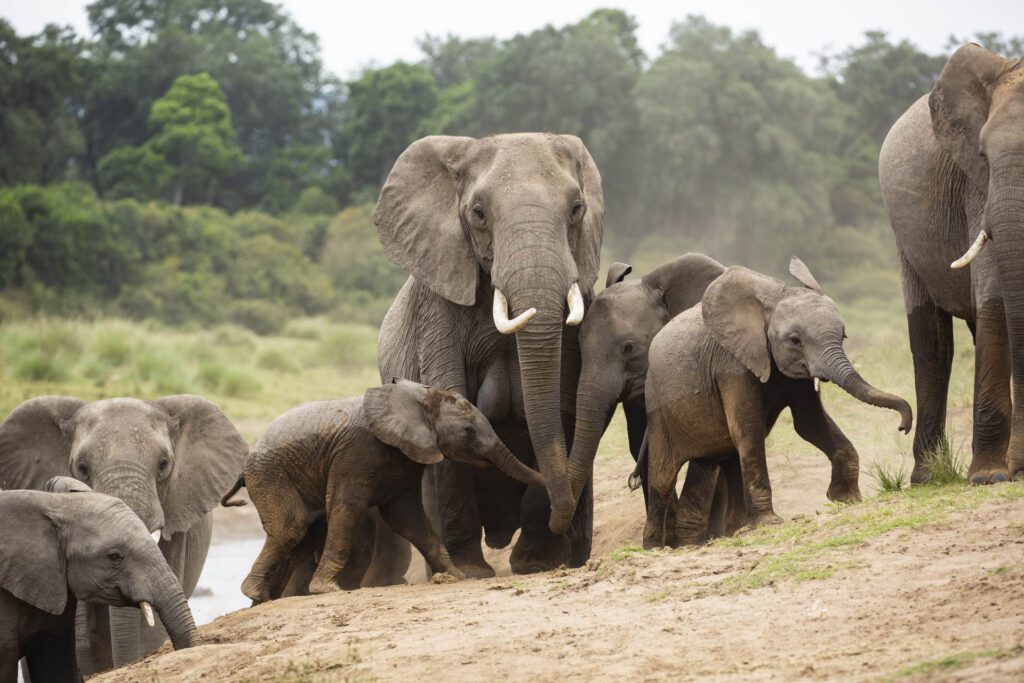
- Calf interactions — young calves play, stumble, nurse, and chase each other constantly. A calf tucked under its mother’s belly, a juvenile attempting to climb a bank, a newborn taking its first uncertain steps — these are the frames that define an elephant photography session
- Tactile moments within the herd — elephants touch each other constantly. A trunk resting on another’s back, a younger animal leaning into an elder, two bulls sparring at the water’s edge — look for contact between animals rather than isolated portraits
Alert and threat behaviour
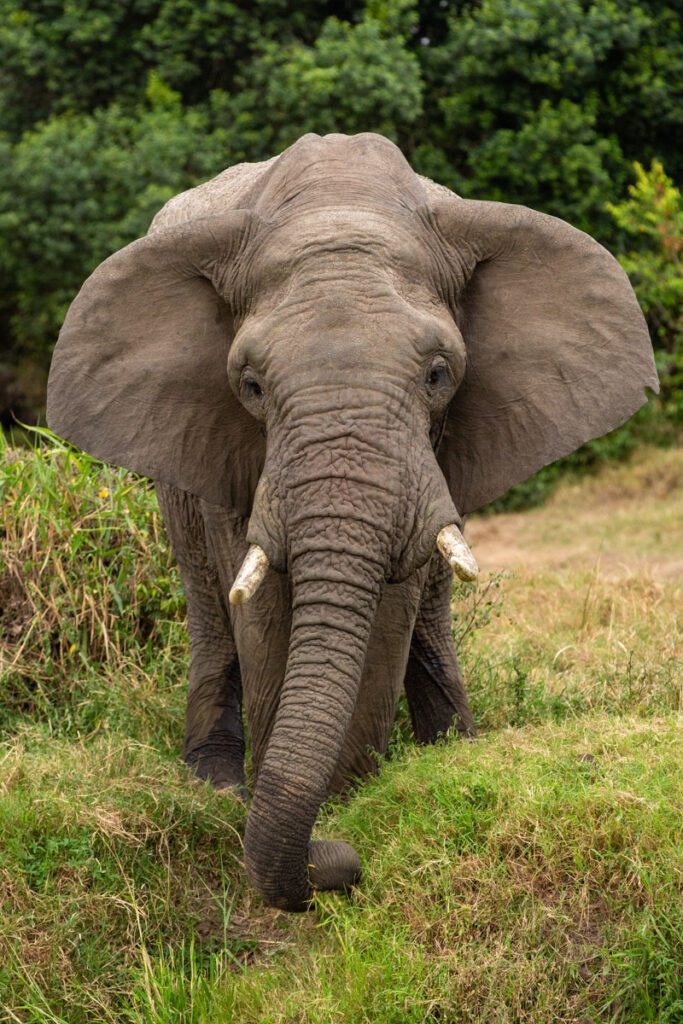
When an elephant raises its head, spreads its ears, and faces your vehicle directly, it is assessing you. This is not a moment to lower your camera — it is one of your best compositional opportunities. A head-on elephant with ears fully spread fills a frame with presence and power unlike almost any other wildlife subject. Your guide reads the difference between a mock charge and a genuine one. Trust that read and keep shooting.
Movement behaviour
A herd on the move is your most technically demanding elephant subject and your most rewarding. The dust, the sound, the sheer mass of animals in coordinated motion — this is the frame most photographers come to the Mara hoping to capture and find hardest to execute. The key is anticipation. Watch the matriarch. She decides the direction and pace of the herd. Position yourself ahead of her line of travel, not alongside it, and let the herd move through your frame rather than chasing it.
The Scale Problem — and How to Solve It in the Frame
Scale is the defining compositional challenge of elephant photography. An elephant that reads as enormous in the field can appear unremarkable in a photograph without the right framing decisions. This is one of the most important skills to master on a Masai Mara photography tour. Here is how to solve it deliberately rather than accidentally.
Use the environment as a reference
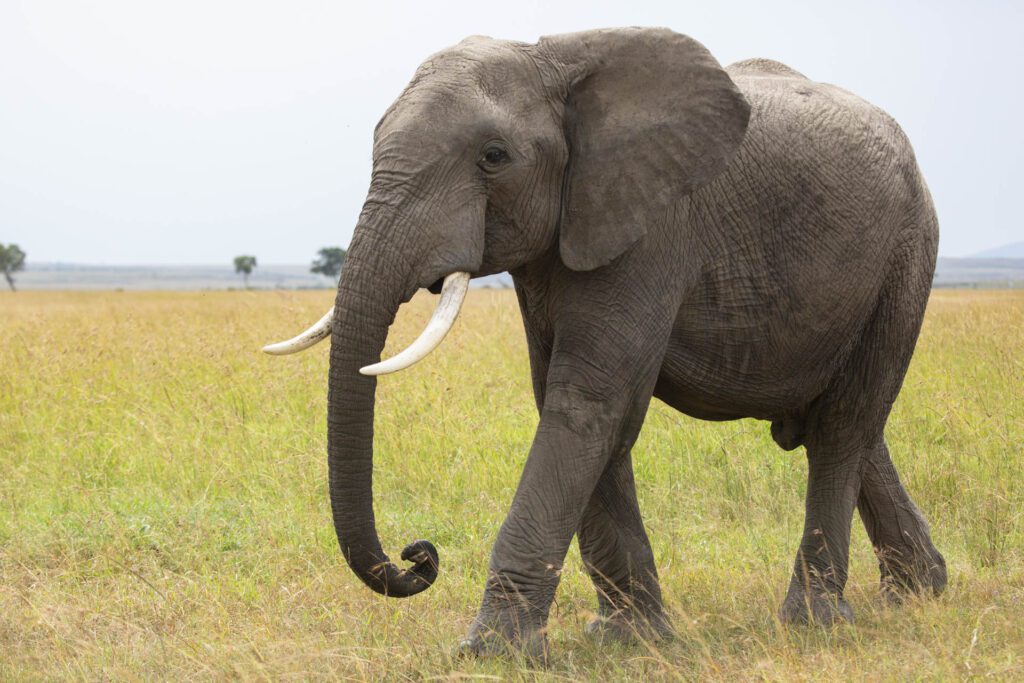
The most powerful elephant images always include an environmental element that contextualises the animal’s size. A single elephant walking through chest-high grass, dwarfing the vegetation around it. A herd crossing a river with the far bank visible, showing how much space they occupy. An elephant beside a vehicle track, the tyre marks emphasising the animal’s footprint. Look for these reference points actively — they are everywhere in the Mara if you train yourself to see them.
Go wide to tell the scale story
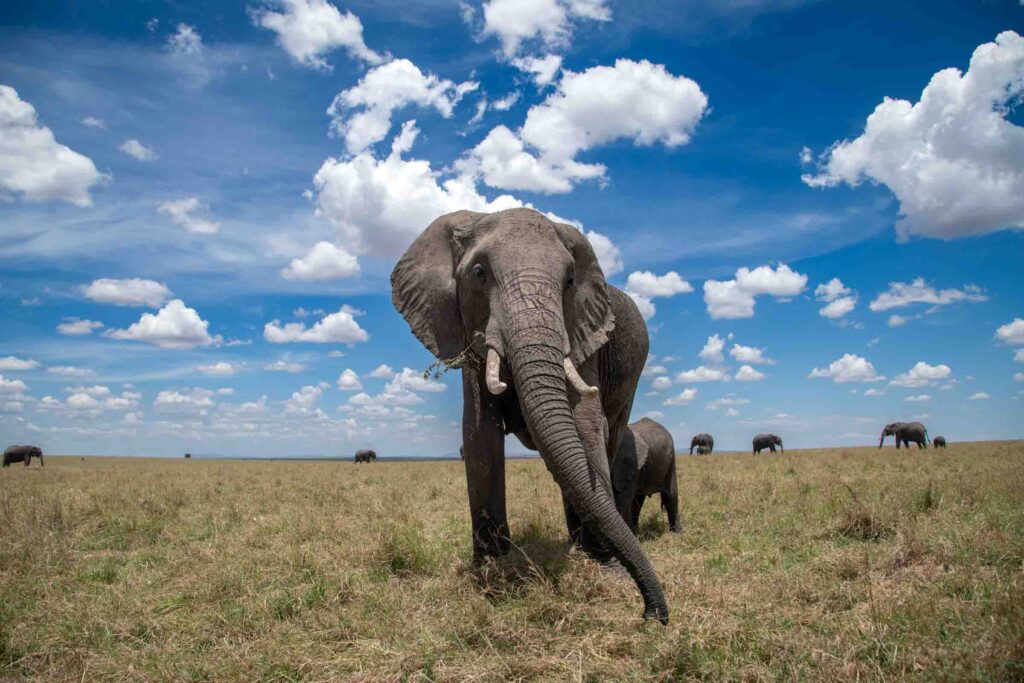
Most photographers default to telephoto for elephant photography. Switch to your wide angle and get the full environment into the frame. A wide shot of a herd moving across open plains with a dramatic sky above communicates scale in a way a compressed telephoto image never can. Wide angle elephant photography is underrepresented in most portfolios precisely because it requires confidence in composition rather than reliance on magnification.
Go tight to tell the texture story
At the opposite end, fill your frame entirely with elephant skin. The wrinkles around an eye, the cracked leather of a knee, the fine hairs along a trunk — these details are invisible to the naked eye at distance but reveal themselves completely through a telephoto lens at close range. Tight detail images pair powerfully with wide environmental shots in any gallery or portfolio presentation.
Use one elephant to represent many
When photographing a large herd, resist the instinct to get every animal in the frame. Instead, isolate one elephant — ideally the matriarch or a calf — and let the out-of-focus shapes of other herd members fill the background. This technique creates depth, context, and narrative without the compositional chaos of trying to frame thirty animals simultaneously.
Frame against the sky
Elephants photographed from a low angle against an open sky read with enormous presence. Position your camera at vehicle floor level, shoot upward, and let the elephant fill the upper portion of the frame with sky below and around it. This angle is underused and immediately distinctive.
Vehicle Positioning and Distance — Where You Sit Changes Everything
In elephant photography, where your vehicle sits relative to the animal is as important as any camera setting. Your guide makes these positioning decisions — but understanding the logic behind them helps you communicate what you are trying to capture and get better results from every encounter. These positioning principles become especially valuable during a Masai Mara photography tour, where wildlife encounters often unfold quickly and photographic opportunities can be fleeting.
The approach angle
A vehicle that approaches an elephant from the front triggers the assessment behaviour — ears spread, head raised, direct eye contact. This gives you the powerful head-on frame but limits your access to the animal’s full profile. A vehicle that approaches from the side gives you the full body, the ear detail, the trunk movement, and the relationship between the animal and its environment. Neither approach is superior — they deliver different images. Tell your guide which frame you are after before the approach begins.
Distance and focal length relationship
The common instinct is to get as close as possible. For elephant photography specifically, this is often wrong. A longer focal length from a greater distance compresses the background and isolates the subject in ways that close proximity cannot achieve. Some of the strongest elephant portraits are made at 200 metres with a 600mm lens, not at 20 metres with a 300mm. Experiment with pulling back and letting the telephoto do the compression work.
Vehicle height and angle
Most safari vehicles position you several feet above ground level. This is excellent for overview shots of herds but works against you for intimate portraits. Ask your guide to find a position where the vehicle sits lower — a gentle depression in the ground, a position on the slope of a bank — to bring your eye level closer to the elephant’s. Eye-level portraits of elephants carry an emotional weight that elevated angles cannot replicate.
Downwind positioning
Elephants have exceptional olfactory senses. A vehicle positioned downwind of a herd gets longer, calmer, more natural behaviour from the animals — which means more photographic opportunity. Your guide manages this automatically, but if you notice behaviour changing as you approach, wind direction is almost always the reason.
Gear and Settings for Your Masai Mara Photography Tour
Elephant photography requires a different gear approach from most other Mara wildlife subjects. Here is what experienced photographers use and why.
Focal length
Carry two focal lengths for elephants specifically:
- 70–200mm or 100–500mm — for environmental and herd shots. This range gives you enough reach to isolate animals while retaining enough width to include landscape context
- 500mm–600mm — for tight portraits, skin detail, and eye shots. The compression at this length transforms elephant skin into something genuinely painterly
Aperture
For single animal portraits, shoot wide open — f/4 to f/5.6 — to separate the subject from the background. For herd shots where you want multiple animals in focus, stop down to f/8 or f/11. For dust and movement shots, wide open aperture with a fast shutter speed gives you the separation between sharp foreground animal and atmospheric background haze.
Shutter speed
Elephants move slower than big cats but faster than they appear. For a moving herd, use a minimum of 1/1000s to freeze motion cleanly. For a stationary animal where you want to capture the subtle movement of a trunk or ear, 1/500s is sufficient. For intentional motion blur — panning with a moving elephant to show speed and energy — drop to 1/60s to 1/125s and pan smoothly with the animal’s movement.
ISO and exposure
Elephant skin is dark. In golden hour light, your camera’s metering will often underexpose to compensate for the bright sky in the background. Dial in positive exposure compensation — typically plus one to plus one and a half stops — to retain skin detail without blowing out the sky completely. In flat overcast light, which is surprisingly good for elephant skin detail, expose to the right of the histogram and pull back in post to reveal the texture.
Bean bag vs tripod
A bean bag on the vehicle window ledge is your primary support for elephant photography. It absorbs vehicle vibration, allows fast repositioning as the animal moves, and keeps you low enough in the vehicle to shoot at near eye level. A tripod is impractical in a moving vehicle and unnecessary for the shutter speeds elephant photography requires.
How Mara Siligi Camp Gets You Closer to the Right Elephant Moment
Elephant photography is not primarily a camera problem. It is a positioning problem, a timing problem, and a patience problem. The camp you choose determines how well all three of these are solved before you ever raise your camera.
Mara Siligi Camp sits at the foothills of Oldonyo Loip Hill, minutes from both Mpuaai Gate and Talek Gate — giving you fast access to the wildlife corridors where elephant herds move daily. You are not spending your golden hour in transit. You are already in position when the light arrives.
Every drive at Camp is private. Your vehicle, your guide, your group only. For elephant photography specifically, this matters more than almost any other subject. Elephant encounters require patience — the willingness to sit with a herd for forty minutes waiting for the right interaction, the right light angle, the right moment a calf does something worth capturing. In a shared vehicle, that patience is impossible. Someone always wants to move on. In a private vehicle, you stay until you are satisfied.
Usha, the wildlife photographer and co-founder at Mara Siligi Camp, has spent years photographing elephants across every season and light condition the Mara produces. That accumulated knowledge shapes how every photography drive is planned — which areas hold herds at which times of day, where the dust light falls best in the late afternoon, which river crossings produce the movement frames that most photographers come specifically to capture.
The full-board structure at our Camp means your midday break between drives is a genuine editing and review session — not a logistics scramble. You review your elephant images from the morning drive, identify what you missed and why, and brief your guide on what you want from the afternoon before you leave camp. That loop — shoot, review, debrief, shoot — is what masai mara photography tour packages at Mara Siligi are built around. It is the difference between coming home with a collection of elephant photographs and coming home with a body of elephant work.
FAQs
Yes. We recommend a private vehicle because elephant photography often requires patience, positioning, and time at a sighting. Our private game drives allow you to stay with a herd as long as the moment demands.
Early morning and late afternoon provide the best light for elephant photography. We schedule our drives around golden hour, when texture, dust, and behaviour create the strongest images.
We suggest carrying both a telephoto lens (400–600mm) for portraits and a mid-range zoom for environmental shots. This combination lets you capture everything from fine skin detail to wide herd compositions.