Masai Mara Photography Tour for cheetah
You came for the cheetah. Maybe you’ve seen the images — a coalition of males mid-sprint across open savannah, dust rising, every muscle in frame. Or a mother crouched low in the golden grass, her cubs watching their first hunt unfold just metres away. Whatever brought you here, one thing is certain: the Masai Mara is one of the best places on earth to photograph cheetah in the wild. And if you do it right, you’ll come home with images that genuinely stop people in their tracks.
At Mara Siligi Camp, we’ve watched guests — beginners and professionals alike — experience that moment when a cheetah steps into perfect light and everything clicks. This guide is about helping you get there — and helping you choose the right one of our Masai Mara photography tour packages for what you’re hoping to shoot. We’ll cover where to find cheetah in the Mara, when to go, how to shoot them, and why the right base makes all the difference.
Table of Contents
- Why the Masai Mara is the World’s Best Place for Cheetah Photography
- Understanding Cheetah Behaviour — the Key to Getting the Shot
- When is the Best Time for Cheetah Photography in the Masai Mara?
- How to Shoot Cheetah: Settings, Lenses & Technique
- Small-Group vs. Large-Vehicle Safaris — Why It Matters for Photography
- What a Cheetah Photography Day Actually Looks Like at Mara Siligi Camp
- Frequently Asked Questions
Why the Masai Mara is the World’s Best Place for Cheetah Photography
Cheetah are notoriously difficult to photograph well. They’re fast, wide-ranging, and in most parts of Africa, shy and difficult to track. The Masai Mara is the exception. The open, short-grass plains of the Mara give you unobstructed sightlines across vast distances. The cheetah here — many of whom have grown up around safari vehicles — are remarkably habituated, allowing you to observe and photograph them at close range without disturbing their natural behaviour.
The Mara also has an unusually high cheetah population for a savannah ecosystem of its size. Famous coalitions and family groups have been tracked and studied here for years, and our guides know their territories, their habits, and their favourite hunting grounds intimately. When you’re out on a game drive with us at Mara Siligi Camp, you’re not searching blindly — you’re working with people who know these animals by name.
Add to that the Mara’s legendary light — warm, directional, and golden for long stretches of morning and evening — and you have a location that is simply unmatched for big cat photography safari work anywhere on the continent. It’s exactly why guests who join our Masai Mara photography tour packages return year after year, chasing that next extraordinary frame.
Understanding Cheetah Behaviour — the Key to Getting the Shot
Great cheetah photography isn’t just about being in the right place. It’s about understanding what a cheetah is going to do next — and positioning yourself for it before it happens. That’s where staying in the Mara, rather than rushing through on a day trip, makes a transformative difference.
Here’s what you need to know:
- Cheetah hunt in the morning and late afternoon. They avoid the midday heat and are most active in the cooler hours — which happen to coincide perfectly with the best photographic light. If you’re on a day trip from Nairobi by road, you’ll arrive well after the morning activity window has closed.
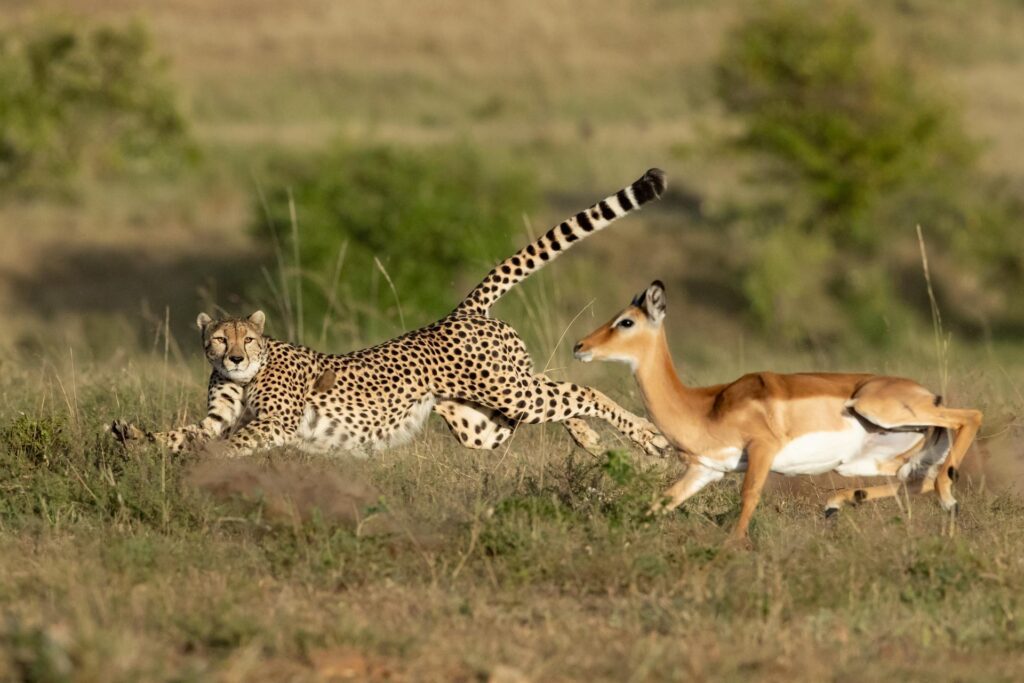
- A hunt unfolds over time. A cheetah might spend 40 minutes stalking before the chase begins. If you arrive at a sighting late or have to leave early to make it back to Nairobi, you’re likely to miss the decisive moment. Staying in the Mara means you can commit to a sighting for as long as it takes.
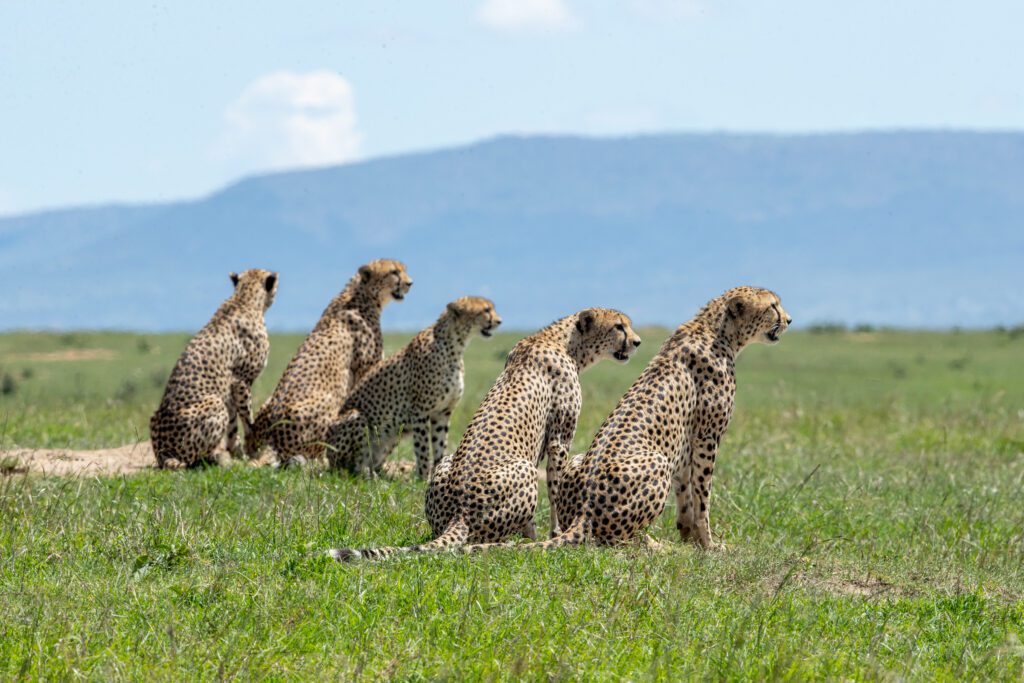
- Cheetah use elevated ground. Termite mounds, kopjes, and fallen logs are a cheetah’s lookout posts. When you spot a cheetah scanning from height, your guide can position the vehicle so the light is behind you and the animal is framed cleanly against sky or savannah — one of the classic frames in wildlife photography.
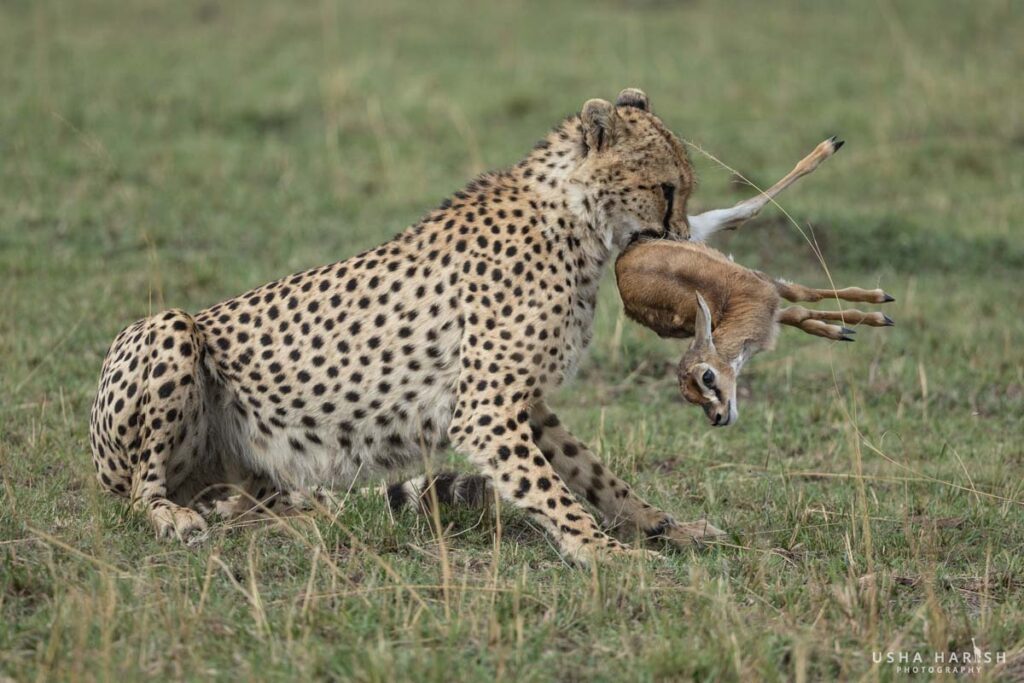
- Post-hunt behaviour is just as photogenic. After a successful kill, cheetah are alert, breathing hard, and often beautifully lit. Cubs interacting with a kill, or a mother teaching her young, are some of the most emotionally powerful wildlife scenes you can photograph anywhere.
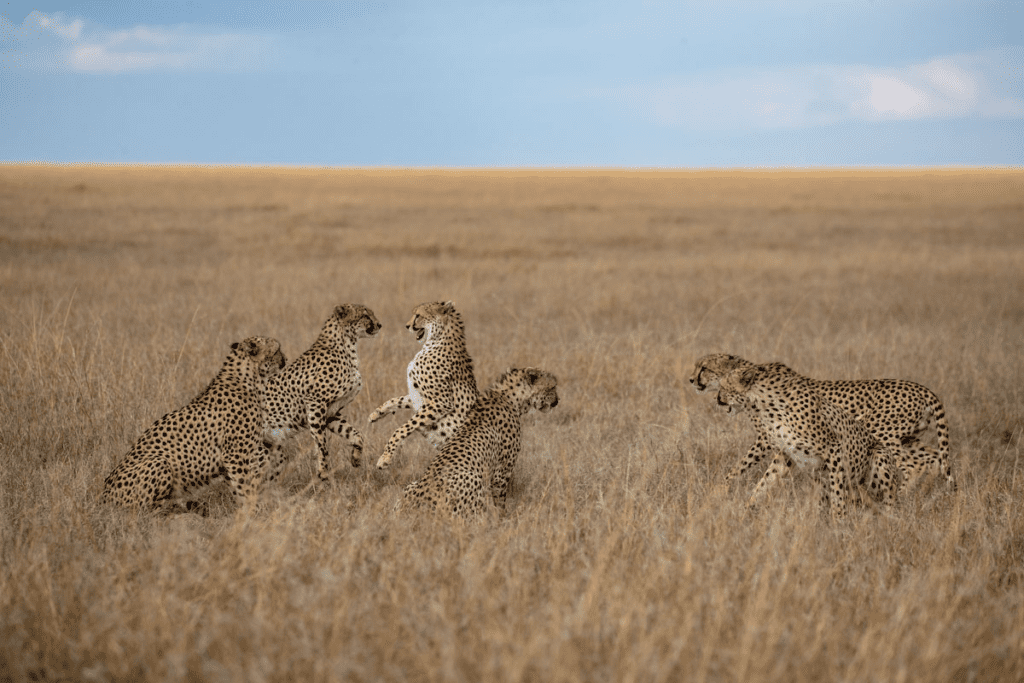
- Coalition dynamics make for extraordinary images. Male cheetah coalitions — sometimes two, three, or even five brothers — hunt together and display incredible coordinated behaviour. Photographing a coalition on the move, or at a kill, produces images with genuine narrative power.
When is the Best Time for Cheetah Photography in the Masai Mara?
The good news is that cheetah photography in the Masai Mara is excellent year-round. Unlike some wildlife experiences that are tightly seasonal, cheetah are resident in the Mara and present throughout the year. That said, certain conditions do favour better photography:
July to October — Peak Season
This is when the wildebeest migration moves through the Mara, and the short-grass plains that the herds graze down give cheetah — and your camera — clear sightlines across enormous distances. Prey is abundant, which means more hunting activity. It’s also the dry season, so dust is manageable and the grass stays low. For a wildlife photography safari Kenya trip focused on cheetah, this window is hard to beat. Our Masai Mara photography tour packages during peak season fill up quickly — so if July to October is your window, we’d recommend getting in touch early.
January to February — The Short Dry Season
A quieter period with fewer visitors, drier conditions, and excellent cheetah activity. The Mara is less crowded and the light in February can be extraordinary — clear skies, warm mornings, and that quality of dry-season air that makes distant subjects look sharp and vivid.
November to December and March to June — The Green Seasons
Taller grass makes cheetah harder to spot and slightly harder to photograph cleanly. However, these months bring their own rewards — lush green landscapes, dramatic skies, newborn cubs in some years, and far smaller crowds. For photographers who want atmosphere and intimacy over pure visibility, the green season has a real magic to it.
How to Shoot Cheetah: Settings, Lenses & Technique
Cheetah are the fastest land animal on earth, capable of reaching 120 km/h in a matter of seconds. When a hunt begins, you have very little time to react. Here’s how to be ready:
The right lens
- A telephoto zoom in the 100–400mm range (or 150–600mm for more reach) is ideal for Mara cheetah photography. You’ll use the longer end for portraits and the shorter end when a cheetah is moving toward you or when you want environmental context in the frame.
- A teleconverter can add reach if you’re using a prime lens, but be aware of the autofocus speed trade-off — during a hunt, you need your AF to be fast and reliable.
Camera settings for the hunt
- Shutter speed: Use a minimum of 1/1600s to freeze motion during a chase. In lower light — early morning or evening — you may need to push to 1/2000s or beyond.
- Aperture: f/5.6–f/8 gives you enough depth of field to keep a moving animal sharp while still throwing the background out.
- ISO: Don’t hesitate to push ISO to 3200 or 6400 in the morning hours. A sharp image at high ISO beats a blurry one at base ISO every single time.
- Burst mode: When the sprint starts, shoot continuously. A cheetah at full speed covers ground in fractions of a second — you want to be capturing every frame.
- Autofocus: Use animal/eye detection AF if your camera has it. If not, use continuous AF with a wide zone or subject tracking. Lock focus early and keep it on the animal as it moves.
Shooting from a vehicle
Almost all cheetah photography in the Mara happens from inside a vehicle. A beanbag rested on the window frame is your best tool — it absorbs vibration and lets you pan smoothly as the animal moves. Practice your panning technique before you arrive. When a cheetah breaks into a sprint, you want muscle memory doing the work, not conscious thought.
The portrait opportunity
Not every cheetah session ends in a hunt. Some of the most powerful cheetah images are portraits — a head-on gaze, a yawn revealing every tooth, a mother grooming a cub. For these moments, drop your shutter speed to 1/500s–1/800s, open your aperture to f/5.6 or wider, and focus on the eyes. The Mara’s golden-hour light falling on a cheetah’s spotted coat at close range is a genuinely breathtaking thing to photograph.
Small-Group vs. Large-Vehicle Safaris — Why It Matters for Photography
This is something we feel strongly about, and it directly affects the quality of your cheetah photography.
When a cheetah hunt begins, vehicle positioning is everything. The driver needs to anticipate the direction of the sprint, move quietly into a flanking position, and stop at the moment that gives your camera the best angle — ideally with the light behind you and open savannah in the background, not another Land Cruiser.
In a vehicle carrying 8–10 tourists, this is almost impossible to optimise for photography. Someone is always on the wrong side. There’s always someone who wants to video on a phone while you’re trying to settle your beanbag. The driver is managing the expectations of a large group rather than reading the hunt.
Every Masai Mara photography tour we run at Mara Siligi Camp is built around small groups — a maximum of 6 guests per vehicle. Here’s what that means for you:
- You have window space. You can move, reposition, and shoot without elbowing anyone.
- Your guide responds to you. If you need the vehicle moved three metres to the left to clear a bush from your frame, that conversation happens instantly.
- You can stay at a sighting as long as it’s productive. If the cheetah is still there and you’re still shooting, we stay.
- The atmosphere is calmer. Cheetah are sensitive to noise and sudden movement. A quiet vehicle of attentive photographers is less disruptive to the animal’s behaviour than a large, noisy group.
For a beginner-friendly big cat photo tour where you’re still learning your camera settings and need time to compose, a small group also means your guide can advise you in the moment without disrupting everyone else.
What a Cheetah Photography Day Actually Looks Like at Mara Siligi Camp
We want to give you a realistic picture of what a day focused on cheetah photography looks like when you stay with us — because it’s very different from what a day trip can offer.
5:45 AM — You’re up before sunrise. Coffee is ready at camp. The light on the Mara escarpment is just turning from grey to pale gold.
6:00 AM — Your vehicle leaves camp. You’re in the reserve as the sun breaks the horizon. Your guide already has a radio report of a cheetah coalition spotted near a lugga to the north last evening.
6:30 AM — You find them. Three brothers, resting on a low kopje, scanning the plains as the morning light warms from gold to amber. You spend 45 minutes here. You get the portraits. You get the environmental shots with the Mara rolling out behind them. You get the moment one of them stands, stretches, and locks eyes directly with your lens.
7:15 AM — One of the males drops off the kopje and begins moving low through the grass. Something has his attention. Your guide kills the engine. You wait.
7:38 AM — The sprint. It lasts eleven seconds and covers 300 metres. You come away with 400 frames. Perhaps 12 of them are exceptional.
9:30 AM — Back at camp for a full breakfast, time to review your shots, charge your batteries, and talk through the morning with your guide. What worked. What to try differently this afternoon.
16:00 PM — Afternoon game drive. The golden light is building. You find a mother cheetah with two sub-adult cubs. She’s teaching them. You stay until the light fails.
This is what staying in the Mara gives you. This is what no day trip — however well-organised — can replicate.

FAQs
We recommend a minimum of three nights. Day one, you’re finding your rhythm — learning the landscape and getting comfortable shooting from a vehicle. Day two and three are when the real work happens — you know where to look, your settings are dialled in, and you’re making intentional images rather than reactive ones. Some photographers stay five or six nights and tell us it still wasn’t enough.
Absolutely. The Mara is one of the most forgiving environments for beginner wildlife photographers — good light, open landscapes, and relatively predictable animal behaviour once you understand the rhythms. Our guides are patient and knowledgeable, and a beginner-friendly big cat photo tour is something we genuinely do well. Bring your camera, bring your curiosity, and we’ll take care of the rest.
Our location, our guide expertise, and our small-group game drives are the three things photography guests consistently mention. We’re inside the ecosystem — not driving to it. Our guides have deep knowledge of specific animals and territories. And our vehicle sizes mean you always have space, light, and the flexibility to stay at a sighting until you’ve got the shot you came for. Explore our Masai Mara photography tour packages and get in touch — we’ll match you with the right option for your dates, experience level, and photography goals.