
Birdwatching on a Masai Mara Travel Package
Most people book a Masai Mara safari for the Big Five. They leave talking about the birds.
The Masai Mara is one of Africa’s most biodiverse avian ecosystems — home to over 570 recorded bird species across grasslands, riverine forests, wetlands, and open plains. If you are a dedicated birder, it belongs on your list. If you have never picked up a pair of binoculars in your life, the Mara will probably change that.
This guide covers everything you need to know about birdwatching as part of your Masai Mara travel package — from the species you are most likely to see to the best time of year, and exactly how we build birding into a stay at Mara Siligi Camp.
Table of Contents:
- Why the Masai Mara Is a World-Class Birdwatching Destination
- The Best Time of Year for Birdwatching in the Mara
- The Birds You Are Most Likely to See — and Where to Look
- Birdwatching at Mara Siligi Camp — What We Offer
- How to Combine Birding With a Big Five Safari Package
- Tips From Our Guides: Getting the Most From Birding in the Mara
- How to Add Birdwatching to Your Masai Mara Holiday Package
Why the Masai Mara Is a World-Class Birdwatching Destination
Most travellers who include birdwatching in their masai mara safari package do so as a secondary activity. They quickly discover it deserves far more attention than that. What surprises many first-time visitors is not just the number of birds in the Mara — it is the sheer diversity you encounter within a very short distance. Even guests arriving primarily for big cats and the Great Migration often leave talking about the birdlife just as enthusiastically.
The Mara ecosystem supports an extraordinary range of habitats within a relatively compact area — and each habitat attracts a distinct bird community. In a single morning drive, you can move from open grassland to acacia woodland, cross a seasonal stream bordered by fig trees, and end at the Mara River with its colony of nesting birds. Each transition brings an entirely different set of species.
Depending on the season, you may encounter everything from massive martial eagles scanning the plains to brilliantly coloured lilac-breasted rollers perched beside the tracks. Early mornings in the Mara are especially rewarding for bird activity, with calls, movement, and raptor sightings often beginning before the larger mammals become active.
The numbers speak for themselves:
- Over 570 bird species recorded in the Greater Mara ecosystem
- 57 raptor species — one of the highest concentrations of birds of prey anywhere on the continent
- 6 of Africa’s 9 vulture species recorded in the Mara
- Several East African endemics and near-endemics not found elsewhere in Kenya
For context: the United Kingdom has recorded roughly 620 bird species in total — across an entire country. The Mara gives you 570 within a single ecosystem. If you are even mildly curious about birds, a masai mara travel package that builds in dedicated birding time is one of the most rewarding safari decisions you can make.
The Best Time of Year for Birdwatching in the Mara
The honest answer is: the Mara is worth visiting for birds at any time of year. But two windows stand out. Because the ecosystem supports both resident and migratory species, the birdlife changes constantly through the seasons, giving repeat visitors a very different experience depending on when they travel.
For serious birdwatchers, timing can shape not just the number of species you see, but the overall pace and atmosphere of your safari experience.
November to April — The Migratory Season
This is the single best birdwatching period in the Mara. Between November and April, resident species are joined by hundreds of thousands of Palaearctic migrants — birds that have flown south from Europe and Asia to spend the northern winter in East Africa.
During these months you can expect:
- Yellow wagtails, European rollers, and barn swallows arriving in spectacular numbers
- Steppe eagles and steppe buzzards — among the most commonly seen migratory raptors
- Wheatears, warblers, and flycatchers filling the acacia scrub
- Generally less vehicle pressure in the park, making birding drives more relaxed
The landscape is often greener during this period, seasonal water sources attract additional bird activity, and photographic conditions can be especially rewarding after light rains. For travellers interested in slower-paced safaris with fewer crowds, this season combines excellent birding with a calmer overall atmosphere in the Mara.
The Mara during migration season offers a genuinely different experience from the July–October wildlife peak — and for birders, it is arguably the superior time to visit.
July to October — Migration Season Overlap
If you are visiting for the Great Wildebeest Migration but want to add birding to your masai mara safari package, this window still delivers exceptional birds. Resident species are at their most active, raptors follow the wildebeest herds, and the riverine forest along the Mara River holds some of the most spectacular species year-round.
This period is particularly strong for birds of prey, scavengers, and species associated with large mammal movement. Vultures, eagles, kites, and storks are often seen around crossing points and predator activity, creating dramatic birding opportunities alongside the migration itself.
For many travellers, combining world-class wildlife viewing with high-quality birdwatching is what makes a masai mara tour package feel so complete. Even guests arriving primarily for the migration are often surprised by how much time they end up spending watching the skies as much as the plains.
The Birds You Are Most Likely to See — and Where to Look
Here is a practical breakdown by habitat — the way our guides actually approach a birding drive at Mara Siligi Camp.
Open Grasslands — The Raptor Highway
The Mara’s open plains are raptor territory. Scan fence posts, termite mounds, and low shrubs for:
- Martial eagle — Africa’s largest eagle, capable of taking small antelope
- Bateleur — unmistakable with its crimson face and almost tailless flight silhouette
- Secretary bird — stalking through the grass on long legs, hunting snakes
- Augur buzzard — one of the most commonly seen large raptors in the Mara
- Kori bustard — the world’s heaviest flying bird, walking slowly through the grass
The grasslands are also where you find ostriches, crowned lapwings, and during migration season, enormous flocks of European rollers in their electric blue plumage.
Riverine Forest Along the Mara River
The fig trees and dense vegetation along the Mara River hold some of the most sought-after species on any masai mara holiday package birding list:
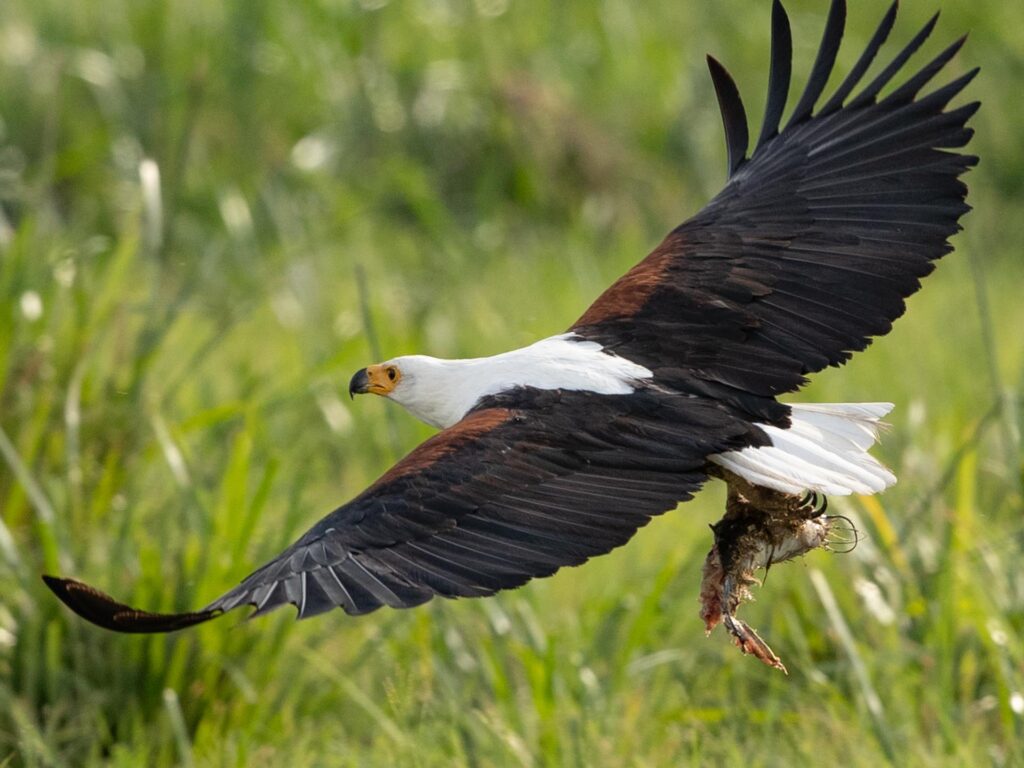
- African fish eagle — its call is the definitive sound of Africa
- Giant kingfisher — Africa’s largest kingfisher, perched low over the water
- Malachite kingfisher — tiny, jewel-bright, hovering over slow-moving shallows
- Black-and-white casqued hornbill — crashing through the canopy
- Schalow’s turaco — one of the most spectacular birds in East Africa, with crimson wing flashes visible in flight
- Pel’s fishing owl — rarely seen, deeply sought after, and occasionally found roosting in large riverside fig trees
Acacia Woodland and Bush Edges
The transitions between open grass and denser bush are consistently productive. Look for:
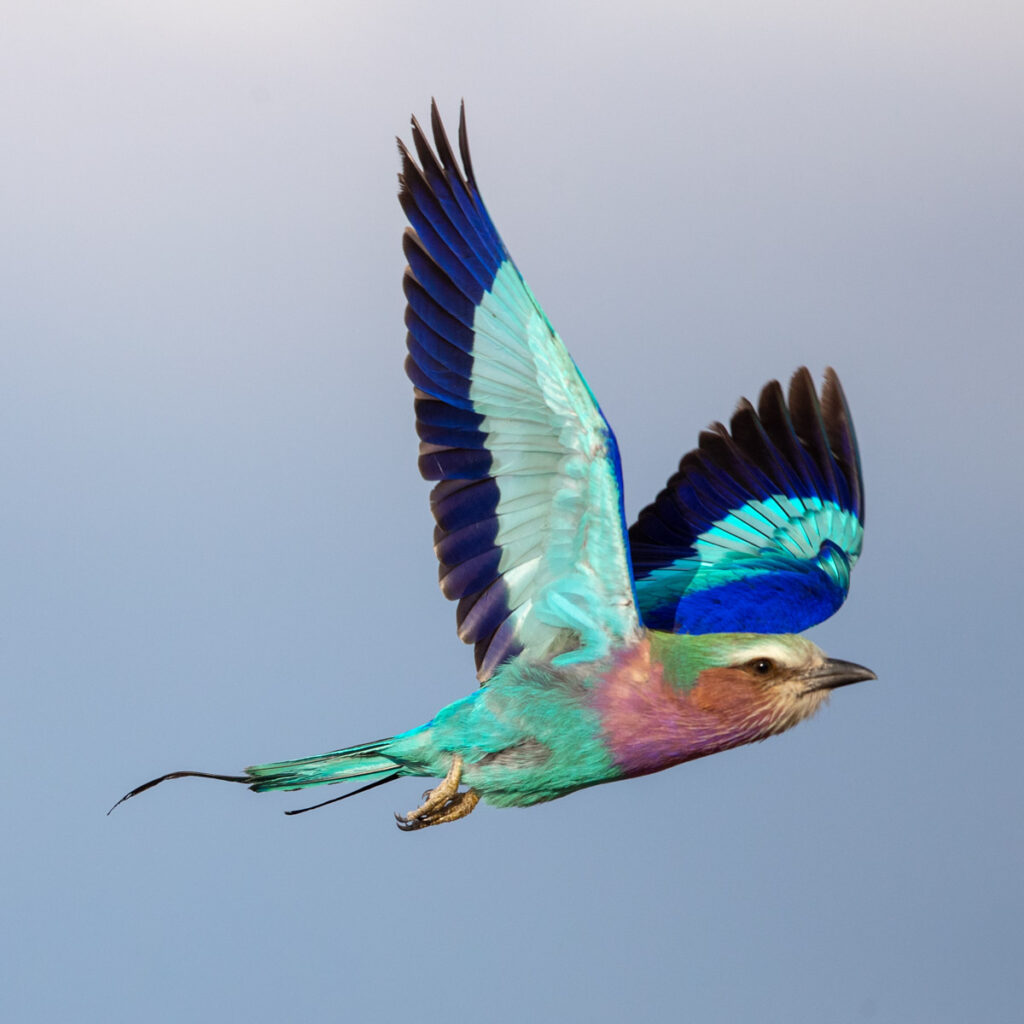
- Lilac-breasted roller — Kenya’s most photographed bird, and deservedly so
- Superb starling — iridescent and surprisingly approachable
- Fischer’s lovebird — small, bright, and gregarious
- Grey-crowned crane — Kenya’s national bird, usually seen in pairs near water
- Tawny eagle and African hawk-eagle — perching high in the canopy scanning for prey
Wetlands and Seasonal Pools
After rains, seasonal pools and drainage lines attract wading birds and waterbirds in significant numbers:
- Saddle-billed stork — Africa’s tallest stork, spectacularly marked in red, yellow, and black
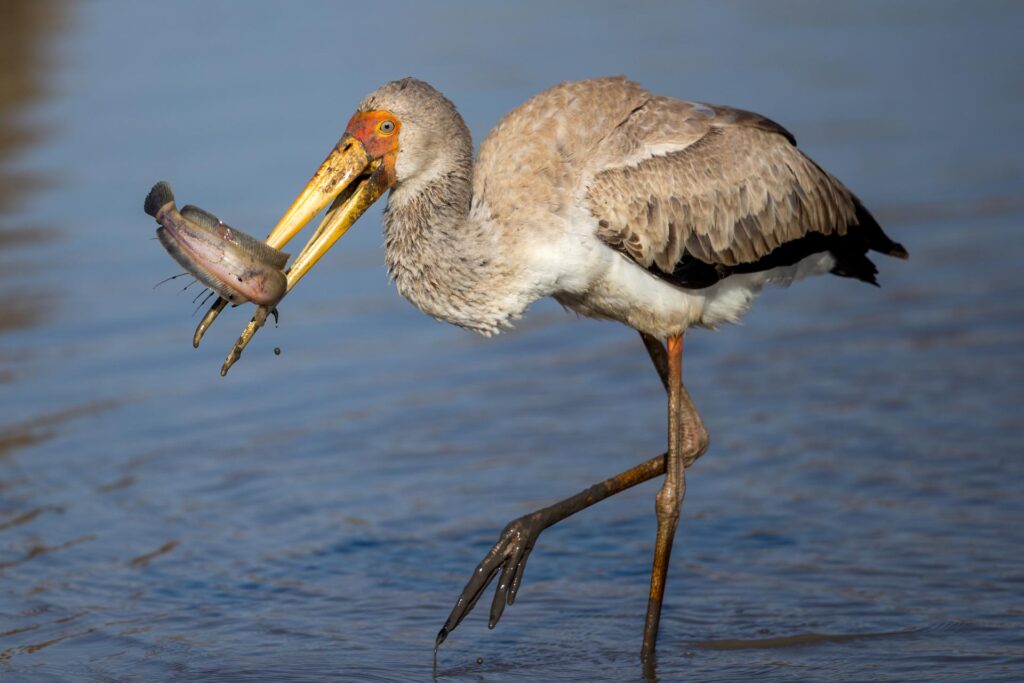
- Yellow-billed stork — wading slowly through shallow water
- African spoonbill — sweeping its spatula bill through muddy shallows
- African jacana — walking on floating lily pads on absurdly elongated toes
Birdwatching at Mara Siligi Camp — What We Offer
At Mara Siligi Camp, birdwatching is not an afterthought bolted onto a standard game drive. It is something we build into the experience for guests who want it. Whether you are a dedicated birder travelling with a species checklist or simply someone curious about the incredible birdlife of the Mara, we tailor the pace and focus of the experience accordingly.
One of the advantages of staying at a safari camp surrounded by varied habitat is that exceptional birding begins almost immediately outside your tent. Many guests arrive expecting birdwatching to happen only during long drives and quickly realise some of the most rewarding sightings happen much closer to camp.
Birding Walks Around Camp
Some of the best birding on any masai mara travel package happens within walking distance of camp. Our guided walks along the camp perimeter and nearby tree lines regularly turn up 40–60 species in two hours — without getting into a vehicle at all.
These walks are slower and more focused than game drives. Your guide moves quietly, stops often, and explains the identification features, behaviours, and calls of each species. For guests new to birdwatching, this is often the moment it clicks.
Walking also changes the way you experience the Mara. Instead of scanning vast landscapes from a vehicle, you begin noticing movement in the grass, calls from the canopy, nesting behaviour, and the smaller details of the ecosystem that are easy to miss during faster-paced wildlife drives.
Dedicated Birding Game Drives
On request, we structure your morning or afternoon drive around birding priorities rather than the standard Big Five circuit. This means:
- Slower driving speeds with frequent stops
- More time at riverine forest sections and wetland edges
- Binoculars and field guide provided on request
- Your guide focused on bird calls, movement, and habitat transitions
Dedicated birding drives are especially rewarding during the migratory season, when mixed-species flocks and raptor activity increase dramatically across the Mara ecosystem. They also suit photographers who prefer a slower pace with more time spent positioning for sightings.
Binoculars and Field Guides at Camp
We keep a small library of East African field guides at camp and have binoculars available for guest use. If you have your own optics, bring them — but if not, we have you covered.
Many guests enjoy spending evenings at camp reviewing the species they spotted during the day, comparing sightings with guides, and learning how to identify birds by call, colour patterns, or flight behaviour. Even travellers who arrive with little prior birdwatching experience often leave surprised by how addictive it becomes once you start paying attention to the details around you.
How to Combine Birding With a Big Five Safari Package
One of the most common questions we get from guests planning a masai mara safari package with birding in mind: do I have to choose between wildlife and birds?
You do not. In fact, the Mara is one of the rare destinations where dedicated birding and big game viewing genuinely coexist on the same drive. It is entirely normal to spend a morning photographing lilac-breasted rollers, secretary birds, and martial eagles — then turn a corner and encounter lions, elephants, or cheetahs within minutes.
Because the ecosystem is so wildlife-rich overall, birdwatching in the Mara rarely feels isolated from the broader safari experience. Instead, it becomes part of a more layered and immersive way of exploring the landscape.
Here is how we typically structure it for guests who want both:
- Early morning drive (06:00–09:30): Dedicated birding window — best light, most bird activity, cooler temperatures for comfortable slow driving
- Mid-morning return: Breakfast and rest at camp
- Late afternoon drive (16:00–19:00): Big game focus — predator activity peaks, golden light for photography
- Evening: Optional guided night walk or camp birding
This structure works within any standard masai mara holiday package stay of 3 nights or more — you do not need to sacrifice either experience to get both.
In practice, many guests end up enjoying the contrast between the two styles of safari. Birding encourages slower observation, attention to detail, and quieter moments in the bush, while Big Five game drives bring the intensity and scale most travellers associate with the Mara. Together, they create a safari experience that feels far richer than focusing on only one aspect of the ecosystem.
Tips From Our Guides: Getting the Most From Birding in the Mara
Our guides have spent years leading birding-focused drives alongside standard wildlife safaris. Here is what they consistently tell guests:
- Bring or hire quality binoculars — 8×42 is the ideal specification for East African birding. Cheap optics in bright sun and deep shade are frustrating; good ones are transformative
- Learn 5–10 target species before you arrive — knowing what you are looking for helps your guide prioritise and helps you appreciate the sighting when it happens
- Ask your guide to focus on calls — in dense riverine forest, you will hear far more than you see. A guide who knows calls is worth more than any field guide
- Do not ignore the common birds — the lilac-breasted roller and superb starling are photographed a million times for good reason. Take the shot. They are genuinely spectacular
- Stay later at the river — most game drive vehicles leave the Mara River by 09:30. If your guide is willing to extend, the riverine forest birding between 09:00 and 11:00 is often the most productive window of the day
- Keep a list — even a rough tally on your phone adds enormously to the sense of achievement and gives you something specific to share with other birders when you return
How to Add Birdwatching to Your Masai Mara Holiday Package
Adding dedicated birding to your stay at Mara Siligi is straightforward. When you contact us, simply tell us:
- Whether you are an experienced birder, a curious beginner, or somewhere in between
- Which species or habitat types interest you most — raptors, waterbirds, forest birds, migrants
- Whether you want dedicated birding drives, guided walks, or both built into your stay
- Your travel dates — so we can advise on what migratory species will be present
We will build it into your masai mara tour package from day one, rather than treating it as an optional extra you remember to ask about on arrival.
Extending Your Birding Beyond the Mara
If birds are your primary motivation, consider pairing your Mara stay with:
- Lake Nakuru — for flamingos, pelicans, and one of the most spectacular waterbird spectacles in Africa
- Kakamega Forest (western Kenya) — a Guineo-Congolian rainforest fragment with species found nowhere else in Kenya
- Lake Baringo — papyrus swamps, cliff-nesting birds, and easy access from Nairobi
We can help you route any of these into a broader masai mara travel package extension. The same approach applies as with any multi-destination Kenya itinerary — you bring the wish list, we help build the route.
Frequently Asked Questions
The Greater Masai Mara ecosystem has over 570 recorded bird species, including 57 raptor species — one of the highest concentrations of birds of prey anywhere on the continent. Six of Africa’s nine vulture species are recorded in the Mara, along with several East African endemics not found elsewhere in Kenya. The ecosystem covers grasslands, riverine forest, acacia woodland, and wetlands, each supporting a distinct bird community within a compact area.
The best time for birdwatching in the Masai Mara is November to April, when hundreds of thousands of Palaearctic migrants from Europe and Asia join the resident species. During this window you can expect yellow wagtails, European rollers, barn swallows, steppe eagles, and steppe buzzards alongside permanent residents. The park is also less crowded during these months, making birding drives more relaxed. July to October is the second strong window — raptors follow the wildebeest herds and riverine forest species remain active year-round.
The Masai Mara offers exceptional birdwatching across four main habitats. On open grasslands look for martial eagles, bateleur, secretary birds, kori bustards, and ostriches. Along the Mara River find African fish eagles, giant kingfishers, malachite kingfishers, and the rarely seen Pel’s fishing owl. Acacia woodland edges hold lilac-breasted rollers, superb starlings, and grey-crowned cranes. Seasonal wetlands attract saddle-billed storks, African spoonbills, and African jacanas. Most guests spot 40–60 species on a guided morning walk near camp alone.