
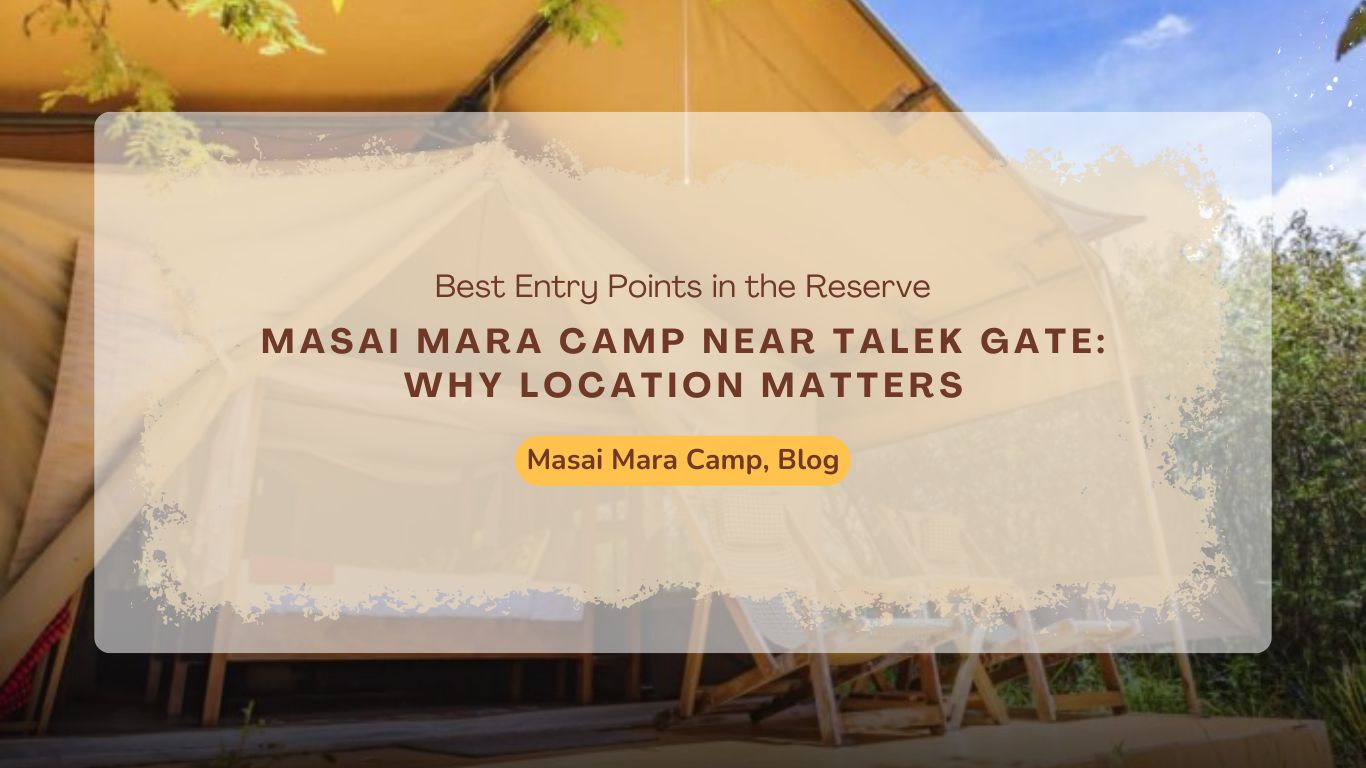
Masai Mara Camp Near Talek Gate
Mara Siligi Camp sits 10 minutes from Mpuaai Gate and 15 minutes from Talek Gate. Every masai mara camp in the eastern reserve has a gate distance — a number that determines how much of your game drive is spent inside the reserve versus on the road getting there. At 10 to 15 minutes, yours starts the moment you cross the fence. As a budget friendly camp near talek that operates with private drives and a small-camp setup, that proximity is compounded daily: more reserve time, earlier entry, later exits.
This guide explains how the Mara’s gate system actually works, why Talek Gate gives you access to some of the best game country in the reserve, and why the distance between your camp and the nearest gate is the single most underrated variable in any safari comparison.
Table of Contents:
- Something We See Every Single Season at Mara Siligi
- How the Mara’s Gate System Actually Works
- Why Talek Gate Is One of the Best Entry Points in the Reserve
- The Real Cost of Staying Far from the Gate — Time
- Where Mara Siligi Sits — and What That Gives You
- The Great Migration and Location — Why They Are Connected
- Location Is Not Everything — But Here Is How to Weigh It
Something We See Every Single Season at Mara Siligi
For first-time safari travellers, gate distance often sounds like a small logistical detail. In reality, it shapes almost every part of your safari experience — from how early you reach productive game areas to how much time you spend actively searching for wildlife versus simply driving to the reserve entrance. Among experienced safari-goers comparing masai mara camps and lodge options, location quickly becomes one of the first things they ask about.
Guests who stayed far from the gates — and what they missed
Every season, we speak to guests who have visited the Mara before — at a different property, further out. The pattern is consistent. They had a good time. They saw animals. But they also describe arriving at the reserve gate to find other vehicles already positioned around a predator sighting that had been active for forty minutes before they got there.
One guest put it plainly: “We were leaving for the gate while everyone else was already inside.” She had stayed at a safari camp in masai mara more than an hour from the reserve boundary on a previous trip. Her morning drive did not begin until 7:15am. Golden hour was gone. The leopard another camp had watched for ninety minutes had moved on. That game loop had already played out before she entered the fence.
This is the hidden difference between a well-positioned safari resort near talek and a camp located far from the reserve entry points. The wildlife experience does not only depend on what animals are present — it depends on when you are able to reach them.
Why location is the one thing most camp comparison guides get wrong
Most masai mara camps comparison guides rank properties by tent quality, food, price, and service. Location — specifically gate proximity — appears somewhere in the middle, rated vaguely as “good” or “well-situated.” That approach misses the point. Location is not just about convenience. It is about how many usable game drive hours you actually get each day.
A budget friendly camp near talek that sits close to productive gates can often deliver a stronger safari experience than a more expensive property positioned much further away. Less transit time means earlier reserve entry, better predator activity windows, more flexibility during migration season, and significantly more time spent inside active wildlife territory.
How the Mara’s Gate System Actually Works
One of the biggest misunderstandings first-time safari travellers have is assuming that all masai mara camps and lodge properties offer roughly the same access to wildlife areas. They do not. The Masai Mara is a vast reserve, and where your camp sits in relation to the entry gates has a direct impact on how your safari unfolds each day.
A well-positioned safari camp in masai mara gives you faster reserve access, more efficient game routes, and significantly more time in active wildlife territory. The difference between a camp ten minutes from the gate and one nearly an hour away becomes visible from your very first morning drive.
Entry, exit, game loops — how the gates shape your day
The Masai Mara National Reserve operates through a formal gate system. Your vehicle enters through a specific gate, pays entry fees, and drives into the zones accessible from that point. The gate you use determines which game circuits you can efficiently run — and how long it takes to reach the most productive wildlife areas.
When you evaluate a masai mara camp, asking for the gate distance is not a minor logistical question — it is the question. A eco friendly camps in Masai Mara positioned close to its gate eliminates dead time entirely. Your driver is not spending forty minutes of your game drive just reaching the reserve fence.
This becomes especially important during early morning drives, when predator movement and golden-hour light create the most productive wildlife window of the day. A safari resort near talek with strong gate access reaches active territory significantly faster than camps positioned further outside the reserve.
The four main gates: Mpuaai, Talek, Sekenani, Oloolaimutia
The four primary entry gates each serve different areas of the reserve:
- Mpuaai Gate — northeastern edge, close to the Talek River corridor, direct access to the eastern plains
- Talek Gate — eastern sector, strong year-round predator territory, migration route access
- Sekenani Gate — southeastern entry, common access point for camps in the Sekenani Valley
- Oloolaimutia Gate — southern gate, used heavily by lodges toward the Mara Triangle
Each gate unlocks different terrain. Proximity to the right gate — matched to where the wildlife is — changes the entire geometry of your day.
Among masai mara stay options, location near Mpuaai and Talek is particularly valuable because these gates provide efficient access to some of the reserve’s most active wildlife corridors.
Which game zones each gate opens up to
Mpuaai and Talek give you direct access to the eastern and northeastern plains — territory covering multiple river crossings during migration season and dense resident predator populations year-round. Every accommodation near Talek gate that operates through these gates reaches productive territory within minutes of entry, rather than after a long warm-up across quieter ground.
For guests staying at a budget friendly camp near talek, this means more usable time inside active game areas and less time spent on transit roads before sightings even begin.
Why Talek Gate Is One of the Best Entry Points in the Reserve
Not all areas of the Masai Mara offer the same wildlife density or driving experience. Certain regions consistently produce stronger sightings because of their terrain, water access, migration movement, and resident predator populations. The Talek corridor is one of those regions — which is why camps positioned near Talek Gate are so highly valued by experienced safari travellers and guides alike.
The game loops you access — and what lives in them
The Talek area encompasses some of the most productive game country in the entire reserve. The Talek River itself is a year-round wildlife corridor — elephants, buffalo, hippo, and big cats all use it consistently. The eastern plains beyond Talek Gate open into wide grassland circuits where cheetah are frequently sighted and lion prides maintain established territories.
A Masai Mara tented camp with proper gate proximity enters this territory from the first kilometre of your drive. You are not warming up across empty land — you are in productive ground immediately.
For guests staying at a safari resort near talek, this means morning drives begin directly inside active wildlife territory rather than spending valuable early hours driving toward it.
Migration routes that pass close to Talek area
The wildebeest migration does not follow a fixed road. It follows water, grass, and terrain. The routes that bring the northern migration column into the Mara frequently pass through the Talek and Mpuaai corridor — the exact territory that a camp accesses most directly.
During peak migration — typically July through October — camps near Talek Gate witness crossings and column movements that properties further south or west must drive significant distances to reach.
This is one of the reasons many experienced safari travellers prioritise accommodation near Talek gate properties positioned in the eastern reserve during migration season.
Crowd levels compared to other gate zones
Talek sits away from the highest-traffic circuits that cluster around the Mara Triangle and Sekenani Valley. Morning drives from Talek Gate feel noticeably quieter than the same hours near the more heavily used western and southern entry points. Fewer vehicles per sighting means better positioning, less interference with animal behaviour, and a fundamentally different quality of game drive.
For travellers looking for a more natural and less crowded safari camp in masai mara experience, the Talek area offers a noticeably calmer pace while still maintaining excellent wildlife density year-round.
The Real Cost of Staying Far from the Gate — Time
When travellers compare masai mara camps and lodge options, they often focus on room style, pricing, or amenities first. What many do not realise until after their safari is that distance from the reserve gate quietly shapes the entire experience. In the Mara, time is not just time — it is wildlife visibility, predator activity, photography light, and how long you are actually inside productive game territory each day.
What a 40-minute drive to the gate actually takes from your day
Most masai mara camp options do not advertise their gate distance prominently. A camp 45 minutes from its nearest gate means 45 minutes each way — 90 minutes of daily game drive time consumed by transit before a single animal is seen.
On a typical three-night stay with two drives per day, that is nine hours of drive time spent outside the reserve. For context: an entire extra day of game driving, lost entirely to distance.
A well-positioned accommodation in masai mara changes that equation completely. Instead of spending the first part of your morning drive simply reaching the reserve, you are already inside active wildlife areas while animal movement is at its peak.
Golden hour, predator activity, the moments that happen before 7am
The hour after first light is categorically the most productive time to be inside the Mara. Predators are finishing nocturnal activity. Herbivores are moving to morning water. Light is at its best for photography. A safari camp in masai mara at 10 minutes from the gate gets you inside the reserve by 5:45am — giving you the full dawn window.
By 7:15am — when a 45-minute camp is just arriving at the gate — a well-located property has already been active inside the reserve for ninety minutes. That window is not recoverable. A budget friendly camp near talek that pairs proximity with private drives gives you what most safari travellers actually came for: undivided time in productive territory from the first light of the day.
For guests staying at a safari resort near talek, this often becomes one of the most noticeable differences compared to previous safari experiences elsewhere in the Mara.
A direct comparison: 10-minute camp vs 45-minute camp
10-Minute Camp | 45-Minute Camp | |
Gate arrival | 5:45am | 7:10am |
Morning drive productive hours | ~4.5 hrs | ~3 hrs |
Afternoon re-entry | 3:15pm | 4:00pm |
Total reserve time (3 nights, 6 drives) | ~27 hrs | ~18 hrs |
Nine hours difference across a single stay — the equivalent of a full extra day inside the Mara.
That difference is exactly why experienced safari travellers increasingly prioritise gate proximity when evaluating masai mara resorts properties.
Where Mara Siligi Sits — and What That Gives You
In the Masai Mara, location is not simply about being “near the reserve.” The exact position of your safari camp in masai mara determines how flexibly your guides can respond to wildlife movement, how quickly you enter productive game territory, and how much of your day is spent driving versus actually experiencing the Mara itself.
10 minutes from Mpuaai Gate, 15 from Talek — what that means daily
Mara Siligi Camp sits at a position that gives guests two-gate access. Mpuaai Gate is a 10-minute drive. Talek Gate is 15 minutes. Depending on morning intelligence from our guides — which direction the herds moved overnight, where predator activity was reported — we choose our entry point accordingly.
This flexibility is only possible because of proximity. A camp positioned this close to two gates can route-plan dynamically, rather than committing to the same entry point every morning by default.
For guests comparing safari camp near Talek River properties, this matters more than many realise. Wildlife movement changes daily. Staying at a safari resort near talek with dual-gate access allows guides to adapt quickly instead of losing valuable drive time repositioning across the reserve.
First into the park, last to leave — how our drives run
Our morning drives leave camp before first light. We are through the gate within minutes of it opening. Our afternoon drives are structured so we use the last permitted light inside the reserve before heading back. With 10 to 15 minutes of transit each way, almost none of your game drive time is spent outside the fence.
This is what being a genuine tented camp near Talek Masai Mara actually means in practice — not a proximity claim in a brochure, but a daily operational difference felt on every single drive.
For travellers choosing a budget friendly camp near talek, this combination of location and efficient drive structure significantly increases actual wildlife time across the course of a stay.
Oldonyo Loip Hill terrain and why it matters for wildlife movement
The terrain around our camp includes the Oldonyo Loip Hill escarpment, which funnels wildlife movement in predictable patterns. Animals use the ridgeline and surrounding drainage for cover and water access — creating consistent sighting opportunities even during drives that stay close to camp. Guests who prefer shorter afternoon drives or conservancy bush walks have productive terrain immediately outside the reserve fence.
This surrounding landscape is part of what makes this masai mara budget camp feel active even beyond the reserve itself. Wildlife movement begins around camp long before you officially enter the gates.
The Great Migration and Location — Why They Are Connected
The Great Migration is often described as a single event, but on the ground it behaves more like a constantly shifting ecosystem. Herd movement changes daily based on rainfall, grazing conditions, river access, and predator pressure. Because of this, the location of your safari camp in masai mara plays a major role in how consistently you encounter migration activity throughout your stay.
Which routes the wildebeest use near the Talek and Mpuaai areas
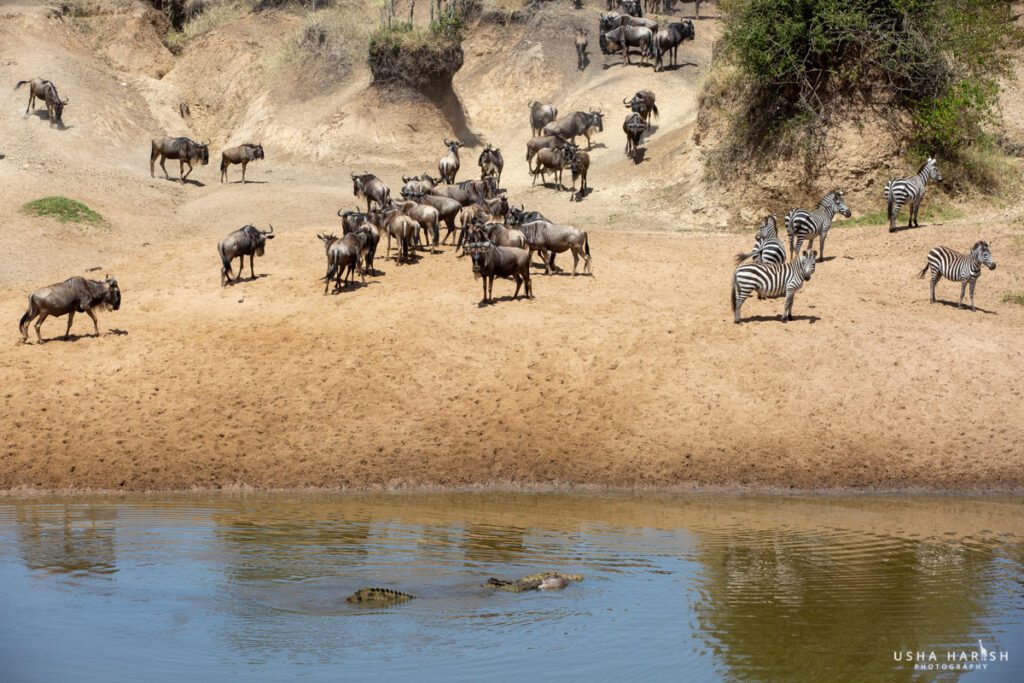
The Great Migration is not a single column moving in a straight line. It is a broad front of animals following rainfall and pasture. The Talek River valley and the eastern plains north of Mpuaai Gate sit directly within the primary migration corridor for herds moving north from the Serengeti into the Mara.
Mara Siligi Camp sits within this migration corridor. During peak season, guests encounter wildebeest columns on their drive to the gate — before they have even crossed the reserve fence. Masai mara camps and lodge properties positioned along this corridor encounter migration animals not just at crossing points, but continuously throughout the day as herds graze through accessible game loops.
For travellers choosing a safari resort near talek, this creates a very different migration experience from camps located further from the eastern plains. Wildlife encounters begin earlier and continue more consistently across the day.
Why camps placed along migration corridors see more — more often
Migration sightings are not only about being at a river crossing at the right moment. The wildebeest are resident in the Mara for weeks. A masai mara resorts that sits along the movement corridors encounters them on morning drives, afternoon drives, and on the transit road between camp and the gate.
A budget friendly camp near talek in this position does not need to drive for an hour to reach migration country. It is already inside it.
This is one of the biggest operational advantages of well-positioned lodge properties during migration season. Instead of chasing herd movement across long distances, your guide is already working within active migration terrain from the beginning of the drive.
Location Is Not Everything — But Here Is How to Weigh It
A well-planned safari is rarely defined by a single factor alone. While location plays a major role in how much wildlife time you get each day, the overall quality of your masai mara safari stays also depends on guiding, camp structure, and how personalised the experience feels once you are actually in the field. The strongest masai mara budget camps properties combine all three effectively rather than relying on scenery or luxury alone.
Location + guide quality + camp size: the three things that together define your safari
Gate proximity matters significantly — but it works in combination with guide knowledge and camp size. A well-located safari camp in masai mara with an inexperienced guide will still underperform a slightly less optimally positioned camp with an exceptional guide.
What you want is the combination: a small masai mara camp close to productive gates, run by guides with deep territorial knowledge, and sized so that your drives are private rather than shared with strangers.
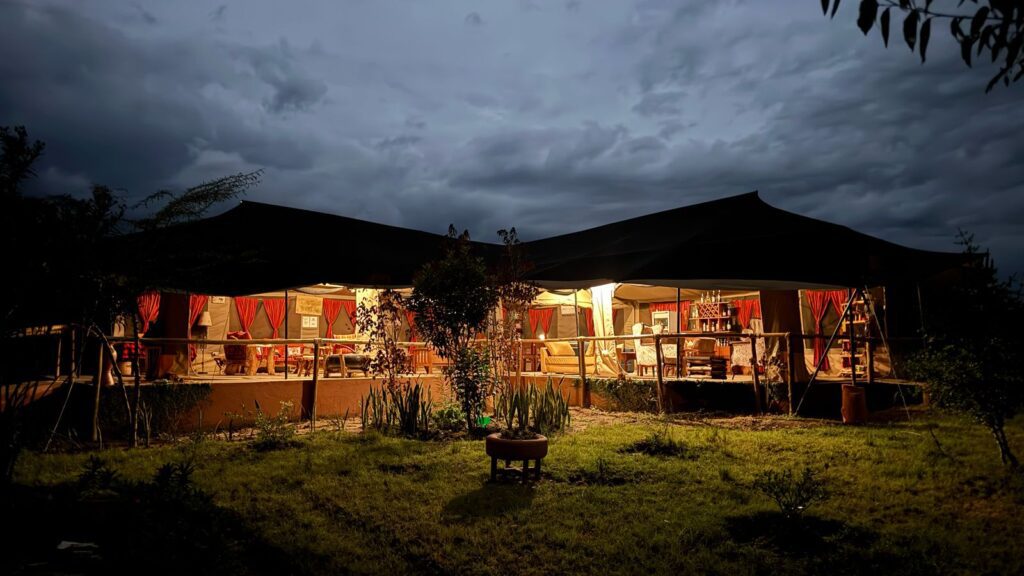
At Mara Siligi Camp, those three things sit together. Ten tents. Guides who have worked this specific terrain for years. Two gates within fifteen minutes.
For travellers comparing a safari camps with modern amenities Masai Mara against larger lodge-style properties, this combination often creates a noticeably more flexible and wildlife-focused experience overall.
What we always tell guests when they ask how to compare camps
When guests ask how to evaluate masai mara tented camps options against each other, we suggest three questions:
- How far is the camp from its nearest reserve gate — in minutes, not kilometres?
- Are game drives private or shared with other guests?
- How many tents does the camp run at capacity?
The clearest signal any safari resort near talek can give you is a specific drive time — not a vague claim about being “close to” the reserve. Press for the number. It tells you more than any tent photograph.
A property that answers well on all three questions will consistently outperform a larger, more distant camp on the thing that matters most: actual wildlife time inside the fence.
For many travellers, choosing a Masai Mara tented camp that balances location, guiding quality, and smaller camp size ultimately creates a stronger safari experience than simply booking the largest or most luxurious-looking property available.
As a budget friendly camp near talek that does not compromise on guide quality or drive structure, Mara Siligi Camp offers the full small-camp safari experience from one of the best-positioned sites in the eastern Mara. Every masai mara camp in the reserve makes promises about wildlife access. Ours is 10 minutes from the gate.
FAQs
Gate distance directly affects how much of your safari is spent inside the reserve versus traveling to it. A camp close to Talek or Mpuaai Gate allows earlier entry, faster access to wildlife zones, and more time in active game areas during peak predator activity.
Talek Gate opens into some of the most productive wildlife corridors in the Masai Mara, including the Talek River and eastern plains. Staying nearby means shorter transit time and quicker access to high-density predator zones and migration routes, improving overall sighting opportunities.
A camp located 40–45 minutes from the gate can lose up to 90 minutes per day in transit time. Over a multi-day safari, this can add up to nearly a full day of missed game drive time compared to a camp just 10–15 minutes from the reserve entrance.