
Yes, November and December are excellent months for birdwatching in the Masai Mara. Migratory birds from Europe and Asia are in the reserve. The short rains turn the plains green. Resident birds get busy breeding. You also share the tracks with fewer vehicles than during the July–October migration rush.
This guide shows you which birds to look for, where to find them, how to prepare, and how we can build a birding-focused trip around you on our Masai Mara safari tours.
Table of Contents:
- Birdwatching in the Masai Mara During November and December
- Migratory Birds to Spot in the Masai Mara During the Short Rains
- Best Habitats for Birdwatching in the Masai Mara
- Birdwatching Tips for the November–December Season
- What to Pack for a Birdwatching Safari in the Masai Mara
- Birdwatching at Mara Siligi Camp
Birdwatching in the Masai Mara During November and December
November and December are among the best months for a Masai Mara birdwatching safari. Migrants from the north are present, the landscape is green, and the busiest crossing season has ended, so drives feel calmer.
Here is why this window works so well for you:
- Migrants and residents share the same plains. You can tick off both in a single morning drive.
- The short rains bring green grass and insects. Insect-eating birds gather where the food is.
- Resident birds are breeding. Many species look their sharpest, and you may see nesting behaviour.
- Fewer vehicles. Our packages page notes fewer vehicles and excellent photography light from November to March.
- Family-friendly timing. December–January is ideal for families, so you can bring the whole group.
The short rains can bring showers, so we plan your days around them. Mornings give you the best light and the most bird activity. If clouds roll in, your guide adjusts the route.
How November–December compares with migration season
July–October | November–December | |
Main draw | Great Wildebeest Migration; Mara River crossings peak early August to mid-September | Migratory and resident birds, green landscapes, soft photography light |
Crowds | The busiest, most in-demand season | Fewer vehicles |
Planning | Riverfront-adjacent camps book out 6 to 12 months ahead | Tell us your dates and we will confirm availability |
Best for | Travellers chasing river crossings | Birders, photographers and families |
Birding is rewarding in any month. November and December simply give you more time to stop, watch and listen.

Migratory Birds to Spot in the Masai Mara During the Short Rains
During the short rains, look for European bee-eaters, Eurasian rollers, white storks, Abdim’s storks, steppe eagles, steppe buzzards, barn swallows and red-backed shrikes. Many of these birds spend the northern winter in Africa, so they are in the Mara while you are.
Arrival dates and numbers change from year to year. We can’t promise any single species, but you give yourself strong odds with a patient guide and a few days on the ground.
Migrant birds to look for
Bird | What to look for | Where to look |
European bee-eater | Slim, colourful bird that snaps up insects in flight | Perches on bushes and open grassland edges |
Eurasian roller | Blue and chestnut bird that drops from a perch to catch prey | Bush tops and open savanna |
White stork | Large black-and-white bird walking through grass | Open plains and damp ground |
Abdim’s stork | Smaller, darker stork with a white belly, often in flocks | Grasslands after rain |
Steppe eagle | Big brown eagle that often stands on the ground | Open plains, especially where insects are active |
Steppe buzzard | Brown buzzard watching from a low perch | Small trees and termite mounds |
Barn swallow | Forked tail, fast low flight | Over grass and water |
Red-backed shrike | Small hunter that sits upright on thorny twigs | Acacia scrub |
We often see bee-eaters, rollers and swallows working the insect surge that follows rain. Raptors use the same plains to hunt and rest.
Resident birds that still steal the show
You do not need to wait for a migrant to enjoy a great morning. These residents are regular favourites:
- Lilac-breasted roller: Kenya’s national bird and a photographer’s favourite
- Secretarybird: Strides through the grass hunting on foot
- Grey crowned crane: Gold crest, elegant and easy to love
- Ground hornbill: Big, bold and fun to watch
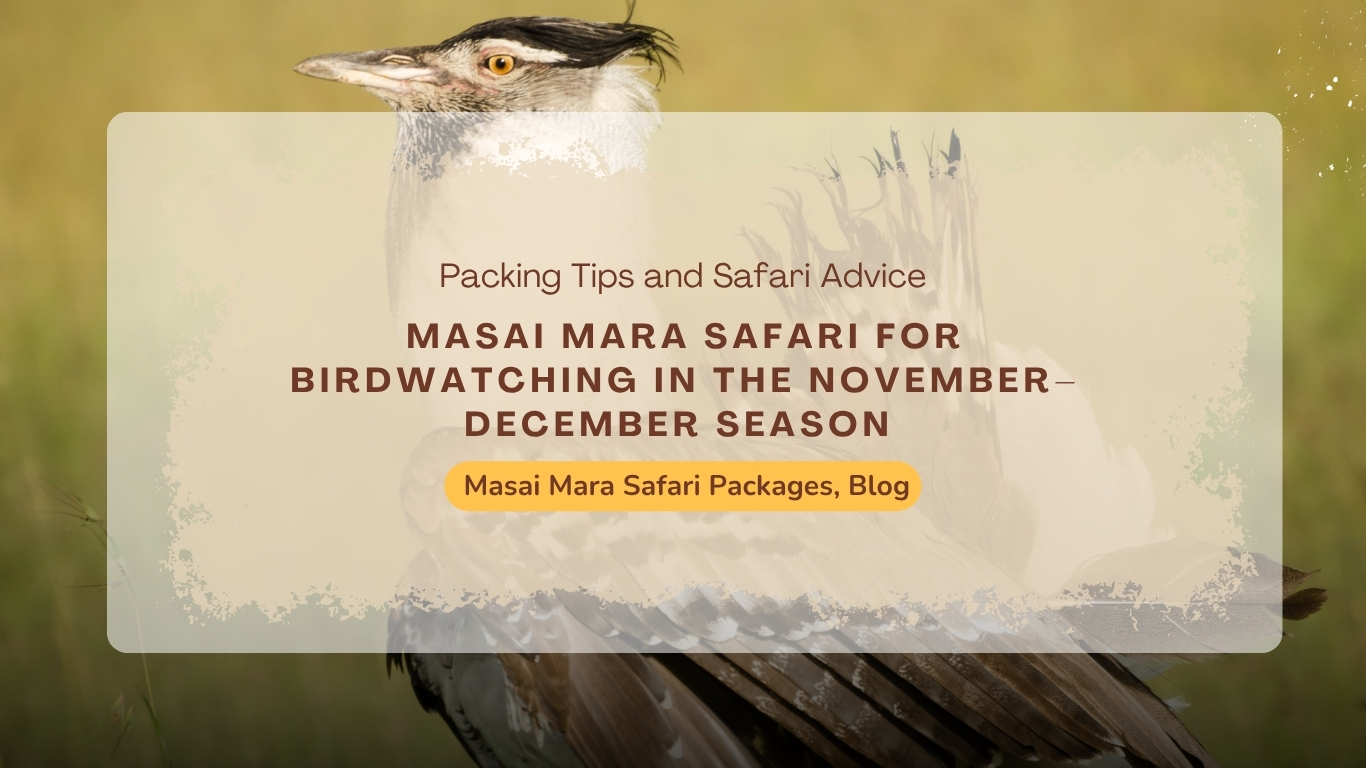
- Kori bustard: One of the heaviest flying birds
- Ostrich: The tallest bird, often seen near plains game
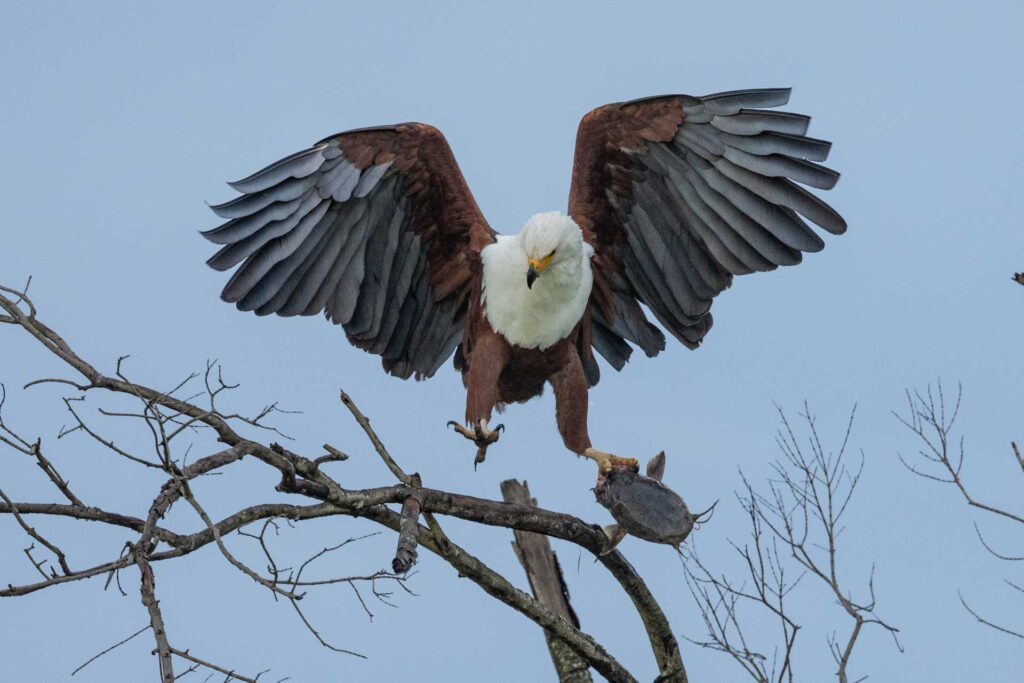
- African fish eagle: Look near the river
- Hamerkop and saddle-billed stork: Water-edge specialists
- Vultures and martial eagles: Watch the sky and the tall trees
In the green season, widowbirds and weavers can show off breeding plumage and build nests. Ask your guide to point them out.

Best Habitats for Birdwatching in the Masai Mara
The best birding habitats in the Masai Mara are riverbanks and riverine forest, open grassland, acacia woodland, marshy ground and rocky slopes. Each one holds different birds, so mixing them in one day gives you the longest list.
The Mara is not one landscape. It is a patchwork, and your guide reads it like a map.
Habitat | Birds you may find | Why it works in November–December |
Mara River and riverine forest | African fish eagle, hamerkop, Egyptian goose, kingfishers, saddle-billed stork | Water and tree cover hold birds all day |
Open grassland | Secretarybird, Kori bustard, ostrich, grey crowned crane, larks, migrant storks | Fresh grass and insects after the rains |
Acacia woodland and thickets | Rollers, shrikes, starlings, weavers | Good perches and nesting sites |
Marshy ground and seasonal pools | Herons, storks, waders | Rain fills shallow pools |
Rocky slopes and outcrops | Eagles, kestrels, vultures | Natural lookout perches |
Why location matters
A quick start to the day means more birding time and less time in the vehicle. That is the idea behind everything we do. We are based minutes from the park gates, so you reach good habitat while the light is still soft.
We use 4×4 game drive vehicles with open roofs and keep groups small, so everyone gets a clear view. Private vehicle options are available on all our packages.
Do not skip the small stuff
Big cats draw the crowds, but small birds often give you the best photos. Ask your guide to stop for any bird that catches your eye. Local guides know where a pair of birds likes to perch and which bush holds a nest.

Birdwatching Tips for the November–December Season
Go out at first light, bring binoculars, ask your guide to switch off the engine, scan perches, and plan at least four nights. Patience matters more than speed.
Here are the habits that help our guests see more:
- Start at first light. Birds are most active in the cool early hours, and the light is lovely for photos.
- Tell your guide on day one that you want birds. You will get a different pace and different stops than a big-cat-only drive.
- Ask for the engine to be switched off. You will hear calls you miss while moving.
- Scan the perches. Check termite mounds, dead branches, bush tops and low trees.
- Look up and look down. Raptors soar high, while secretarybirds and bustards walk the grass.
- Watch the grazers. Birds such as cattle egrets follow animals that stir up insects.
- Rest at midday. Birds go quiet in the heat, and so should you. Head back to camp, then go out again in the late afternoon.
- Stay in the vehicle on game drives. It keeps you safe and keeps wildlife relaxed.
- Keep a daily list. Take photos so you can identify tricky birds later.
- Give yourself time. We recommend a minimum of 3 nights. Four or five nights gives you a much fuller experience.
Use your guide’s network
Our guides talk daily with other guides and camps to track animal movement. Ask them to share bird news too. A quick tip about an eagle on a kill or a stork flock on the plains can change your morning.
A note on photography
If you shoot birds, tell us before you arrive. Our photography packages use custom-timed game drives for golden light, and we run photo review sessions at camp. Birds are on the agenda for the later days of our 6-day photography package.
What to Pack for a Birdwatching Safari in the Masai Mara
Pack binoculars, layers, a light rain jacket, a hat, sun protection, closed shoes, a camera with a long lens, spare batteries and a refillable water bottle. Keep everything light and neutral-coloured.
Category | What to bring |
Optics and camera | Your own binoculars, camera, zoom lens, lens cloth, spare memory cards |
Power | Spare batteries, charging cables, power bank. Our camp has charging points for camera gear |
Clothing | Light layers for cool mornings and warm afternoons, a light rain jacket for the short rains |
Sun and comfort | Hat, sunglasses, sunscreen, comfortable closed shoes, water |
Helpful extras | Small notebook, a bird guide or app, a dust cover or zip bag for your camera |
Our packing advice, in short
- Choose neutral colours. Greens, browns and khakis blend into the bush.
- Bring your own binoculars. You can adjust them to your eyes and use them whenever you like.
- Expect dust and the odd shower. Protect your gear either way.
- Pack light. Safari vehicles and small airstrip flights have limited space.
We also have a simple checklist in our guide on how to prepare for your first game drive in the Masai Mara.
Birdwatching at Mara Siligi Camp
We are a small eco-camp at the foothills of Oldonyo Loip Hill, about 10 minutes from Mpuaai Gate and 15 minutes from Talek Gate. You can add birdwatching to any package, and we will shape your days around the birds you want to see.
At Mara Siligi Camp, you stay in one of 10 eco tents with ensuite bathrooms and a private deck. You can sip your morning tea there and scan the savanna before the first drive. We run on solar power, and you can charge your camera gear at camp.
We are locally owned and operated. Our guides are Masai who grew up reading this land, and they know it the way no guidebook can teach.
Which of our packages suit birders
Package | Length | How birdwatching fits |
Mid-Range Safari Package | 2 to 3 days | A full day of morning and afternoon drives is a good first taste of Mara birdlife |
Masai Mara Photography Tour Package | 6 days | Custom-timed drives for golden light, a photography lounge, photo review sessions, and specialised sessions on birds in the final days |
Family-Friendly Safari Packages | 5+ days | Birdwatching is an optional extra from day 6, alongside child-safe nature walks. There is no minimum age |
Honeymoon or Couples Safari Packages | 4 days | Private drives at your pace, including a sunrise drive. Tell us you want birds, and we will plan around it |
Every package is a starting point. Tell us your dates, your group size and what you love, and we will personalise it.
More ways to connect with nature
- Nature walk and tree planting: Learn the local plants with our in-house naturalist, visit our tree nursery and plant a sapling.
- Stargazing: Zero light pollution and a full Milky Way after your day of birding.
- Private bush dinner: A lantern-lit dinner just outside camp.
- Hot air balloon safari: See the Mara from above, followed by a bush breakfast.
What guests say
We hold a 5.0 rating across 450 reviews on Google and TripAdvisor. One guest wrote that our guides were “fantastic, very knowledgeable and passionate.”
How to get here
- By air: Daily flights from Wilson Airport, Nairobi, to Ol Kiombo or Keekorok airstrips, about 1 hour
- By road: 5 to 6 hours from Nairobi via Narok
We can arrange your transfers, so you start your birding holiday without stress.
Ready to Plan Your November–December Birding Trip?
November and December give you migrants, green plains, quieter tracks and soft light. You bring the binoculars. We bring local guides, a comfortable base and a plan built around you.
When you are ready to start your Masai Mara safari booking, tell us your dates, how many people are travelling and which birds or experiences matter most. We reply within 24 hours with a personalised package, pricing and availability. Everything is itemised upfront, with no hidden costs.
Frequently Asked Questions
For serious birders and bird photographers, our 6-day photography package is the best fit. It includes custom-timed drives for golden light, photo review sessions and specialised sessions on birds. If you have less time, our mid-range 2 to 3 day package still gives you full days of game drives, and you can ask your guide to focus on birds.
We recommend a minimum of 3 nights. Four or five nights gives you a fuller experience, with more time to revisit habitats, catch the best light and slow down between drives. Birders who also want photography time should consider our 6-day package.
Yes. We have no minimum age. Our family-friendly packages include family tents, flexible drive timing and child-safe nature walks, and birdwatching is an optional extra from day 6. Our camp is electric-fenced, and our guides know how to pace a day for younger guests.